All journeys · Breeding and relationships
Two parents. Two new mangoes.
Meet Neelum and Dashehari, then follow their reciprocal crosses into Mallika and Amrapali.
Indian research orchards
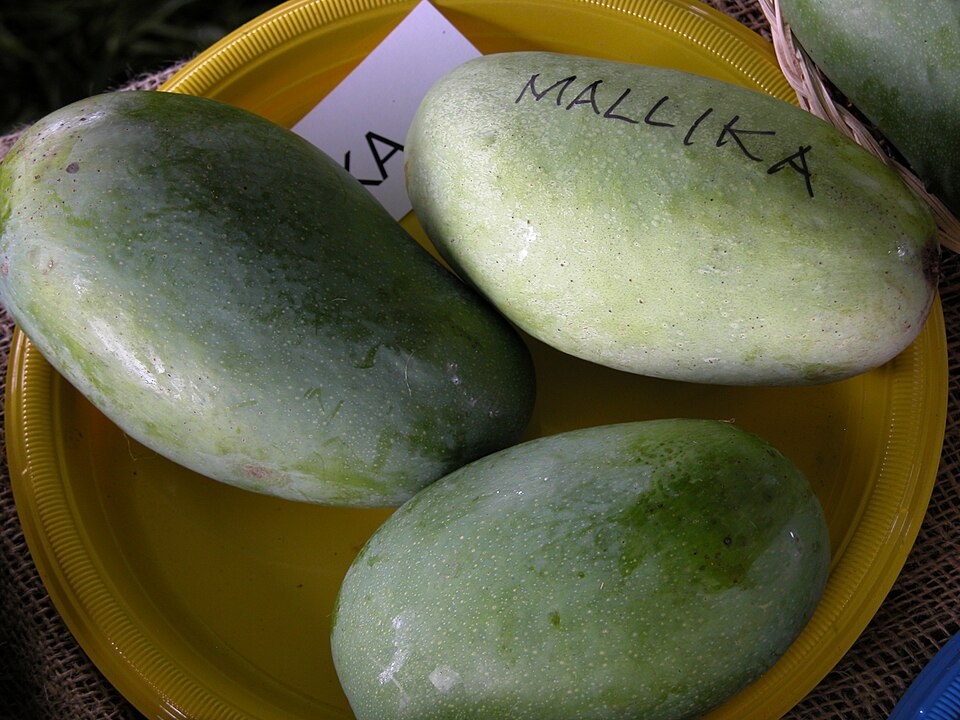
Mallika mangoes at Fruit and Spice Park, Homestead, Florida. Maturity is not specified. Mallika is one of the two hybrids in this journey.
Mango Mallika Asit fs.jpg — Thaumaturgist. Photograph source · CC BY-SA 3.0.

Resized for display; complete frame retained. No generative edits.
Mango heritage keeps growing. Breeders bring established varieties together, grow their offspring and select new fruit. Mallika and Amrapali make an unusually clear introduction to a family tree: the same named parents, crossed in opposite directions.
Stop 1 · Southern India · record
Start with a parent.
Neelum
Neelum appears in both crosses recorded by IARI. Following its offspring is one way to see why an established variety matters long after newer names arrive.
Stop 2 · Northern India · record
Meet the other half of the cross.
Dashehari
Dushehari · Dasheri
Dashehari is the other named parent. IARI uses the spelling Dushehari in its release descriptions. The pair connects two well-known mango traditions within a deliberate breeding programme.
Stop 3 · IARI, New Delhi · record
Neelum × Dashehari becomes Mallika.
Mallika
IARI records Mallika’s parentage as Neelum × Dushehari. Its cultivar description highlights large, fibreless fruit. Open its profile, then compare the family relationship with Amrapali at the next stop.
Stop 4 · IARI, New Delhi · record
Reverse the cross. Meet a distinct cultivar.
Amrapali
Amrapalli
Amrapali is recorded as Dushehari × Neelum. IARI describes a dwarf, regularly bearing tree. Sharing parents does not make it another name for Mallika: each is a separately selected cultivar.
How does an old variety become part of something new?
Parentage is a relationship between distinct varieties. The two crosses let you follow older mangoes into new generations while keeping each cultivar’s identity intact.