All journeys · African orchards
The orchard behind the mango.
Kenyan Apple, West African Amélie and South African Sabre reveal three different ways a mango’s legacy grows.
Kenya, West Africa and South Africa
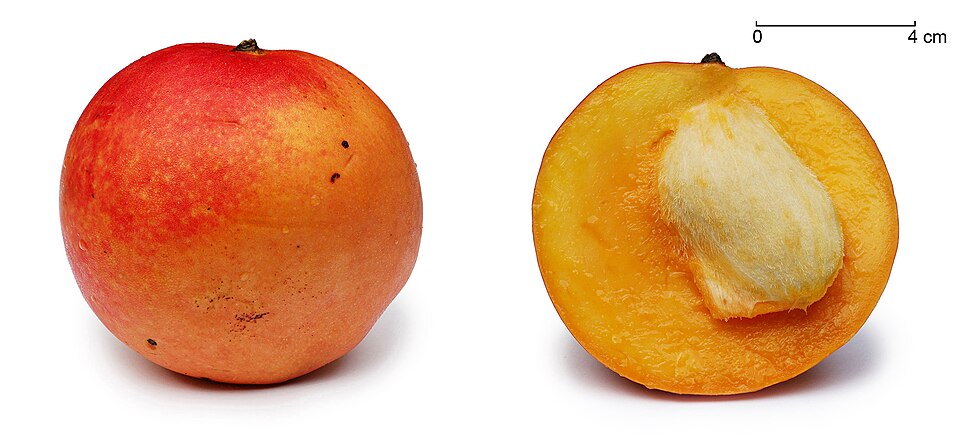
An Apple mango and its seed-bearing cross section, photographed by Muhammad Mahdi Karim. The source does not specify where this fruit was grown. Research distinguishes the Kenyan Apple cultivar from a generic description of apple-shaped fruit. The photograph does not establish a Kenyan growing location.
Apple mango and cross section edit1.jpg — Muhammad Mahdi Karim. Photograph source · GFDL 1.2 or later · Full GNU Free Documentation License 1.2 text.

Resized for display; complete frame retained. No generative edits.
A fruit label tells only part of an orchard’s story. Some trees begin as seedlings; selected varieties are shared by grafting; other mangoes supply the roots beneath a different fruiting variety. These three stops follow those connections through African research and cultivation records.
Stop 1 · Kenya · record
A familiar word needs its growing-place context.
Kenyan Apple
Apple · Kenyan Apple
KEFRI records Apple as a Kenyan cultivar grown around Malindi, Makueni and other areas. It also notes that seed-grown trees can vary in fruit shape, colour and quality. “Apple” opens the record; the Kenyan context and the way a tree was propagated tell you much more.
Stop 2 · West Africa · research
Grafting connects neighbouring orchards.
Amélie
CIRAD’s regional study places Amélie among the earlier mango varieties spread by grafting in West Africa. It examines orchards in Guinea, Mali, Burkina Faso, Côte d’Ivoire, Senegal and Togo, showing how history and the destination of the harvest influence what people grow. Amélie’s regional story stretches beyond a single country label.
Stop 3 · South Africa · research
An influential mango can live below the graft.
Sabre
Sabre
The Agricultural Research Council records Sabre seedlings in South Africa’s early commercial orchards. Later ARC research evaluates Sabre as a rootstock supporting other named cultivars. That is a physical relationship within a grafted tree, distinct from a parent-and-offspring relationship produced by breeding.
Which part of a mango tree carries its history?
Seedlings, grafted varieties and rootstocks preserve different kinds of diversity. A useful mango collection follows those roles as carefully as the fruit that reaches a market.