Apple Mango
Round, vivid, and richly sweet with a balancing citrus edge.
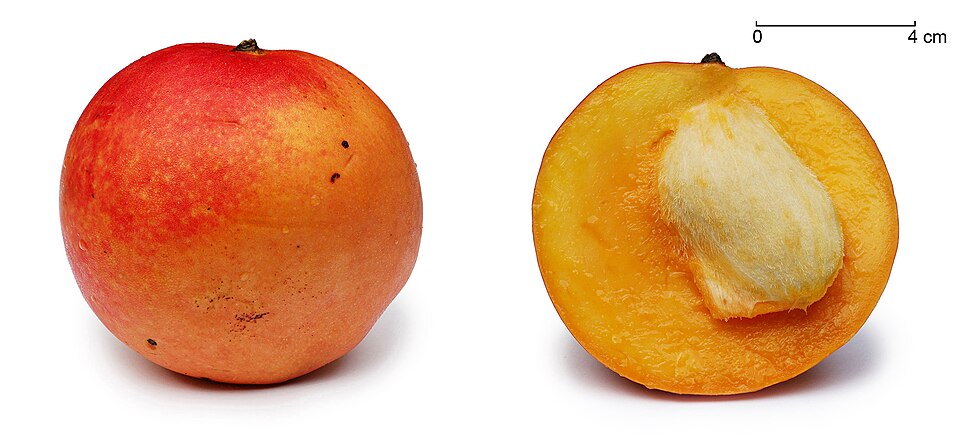
An Apple mango and its seed-bearing cross section, photographed by Muhammad Mahdi Karim. The source does not specify where this fruit was grown.
Apple mango and cross section edit1.jpg — Muhammad Mahdi Karim. Photograph source · GFDL 1.2 or later · Full GNU Free Documentation License 1.2 text.

Resized for display; complete frame retained. No generative edits.
How it tastes
juicy · Low fibre
- Texture
- juicy
- Fibre
- Low fibre
- Eating styles
- Get sticky
- Harvest
- See regional calendars
How to enjoy it
The apple mango in this guide comes from Kenya. Its rounded shape and firm flesh make a generous plate of slices; a little tang keeps the sweetness lively.
Open over a bowl to catch the juice. Scoop the ripe flesh; strain blended pulp if you prefer less fibre.
When it is ripe
Choose orange-red fruit that gives slightly and smells sweet at the stem.
Flavour notes are subjective. Ripeness, handling and growing conditions change the fruit.
Compare this mango · Saved mangoes
Names, history & sources
Recorded names
A shared name does not by itself establish an identical cultivar. Place, language and source matter.
- Apple Mango
- Apple / Kenyan Apple
The Kenyan cultivar, rather than every mango marketed as apple-shaped.
- Malindi Apple
A geographical name recorded in international horticultural reports.
- Kenyan Apple
Existing catalogue label. It may be an alternate name, translation or market nickname; it is not an assertion of genetic identity.
A chance seedling from the Kenyan coast
Documented history: consult the claims and qualifications in the cited sources.
The World Agroforestry guide describes Apple as a chance seedling from Kenya’s coast, most probably around Malindi. Its parents are unknown. That uncertainty leaves room for the real event at the centre of so many fruit histories: someone noticed a good tree and kept it.
Kenya’s forestry research institute records Apple in several growing districts. “Apple mango” is also used loosely elsewhere for round or blushing mangoes, so the Kenyan place matters when asking for this one. A familiar English word can hide a very particular coastal fruit.
Read the full storyPlaces in this record
Country associations alone do not establish botanical origin.
- Kenya
Catalogue association
Associated place in the tasting catalogue; this does not establish botanical origin.
- Kenyan coast, probably around Malindi
A place in the story
Setting of “A chance seedling from the Kenyan coast”. Read the story for its evidence and qualifications.
Harvest calendars by growing place. These regional calendars do not specify this cultivar’s exact season.