Tommy Atkins
Dependable, handsome, and mostly here because it travels well.
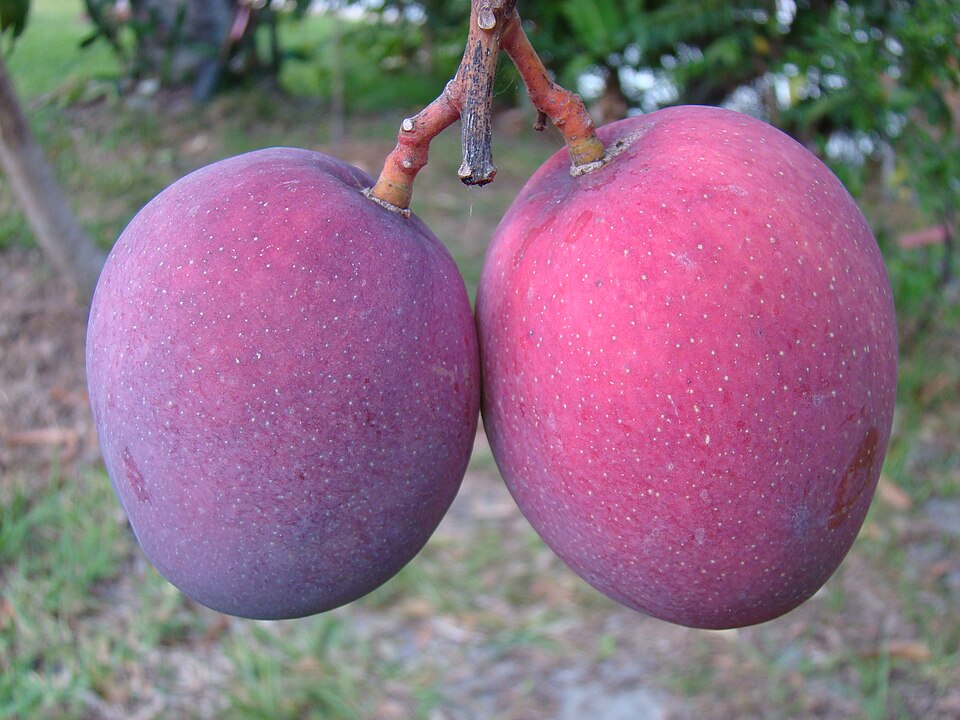
Two Tommy Atkins mangoes on a tree at Ghosh Grove, Rockledge, Florida.
Mango TommyAtkins03 Asit.jpg — Asit K. Ghosh (Thaumaturgist). Photograph source · CC BY-SA 3.0.

Resized for display; complete frame retained. No generative edits.
How it tastes
firm · Fibrous
- Texture
- firm
- Fibre
- Fibrous
- Eating styles
- Slice & eat
- Harvest
- See regional calendars
How to enjoy it
Tommy Atkins is a familiar supermarket mango because it handles transport well. Its firm, fibrous flesh benefits from patience: wait for softness, then try it in a blended drink.
Cut the cheeks away from the flat stone, then slice or cube. Use the ripeness notes below to choose the right stage.
When it is ripe
Softness helps, but it cannot negotiate with all that fiber.
Flavour notes are subjective. Ripeness, handling and growing conditions change the fruit.
Compare this mango · Saved mangoes
Names, history & sources
Recorded names
A shared name does not by itself establish an identical cultivar. Place, language and source matter.
- Tommy Atkins
Venezuela
Named for Thomas H. Atkins of Fort Lauderdale.
- Tommy
A shortened market name.
- The supermarket regular
Existing catalogue label. It may be an alternate name, translation or market nickname; it is not an assertion of genetic identity.
The grower who kept believing
Documented history: consult the claims and qualifications in the cited sources.
Thomas H. Atkins raised the Haden seedling planted in 1922 that would carry his name. He submitted its fruit to the Florida Mango Forum’s variety committee more than once. The committee objected to its fibre and flavour.
Atkins saw something else: attractive fruit, abundant crops and the ability to survive handling. He persuaded growers to plant it, and its commercial journey spread through Latin America and the supermarket trade. Whatever you think of a particular bite, there is a person’s persistence behind that familiar sticker.
Read the full storyPlaces in this record
Country associations alone do not establish botanical origin.
- Florida
Catalogue association
Associated place in the tasting catalogue; this does not establish botanical origin.
- Venezuela
Catalogue association
A mango cultivar included in the Venezuelan INIA-CENIAP collection and flowering research.
- Italy
Research trial
Included in the 2015 orchard experiment, rather than a current availability survey.
- Acquedolci, Sicily, Italy
Research trial
Included in the 2015 orchard experiment, rather than a current availability survey.
- United States
Catalogue association
Associated country guide; cultivation, naming and origin are different claims.
- Fort Lauderdale, Florida, United States
A place in the story
Setting of “The grower who kept believing”. Read the story for its evidence and qualifications.
Harvest calendars by growing place. These regional calendars do not specify this cultivar’s exact season.