Osteen
Firm, low-fiber flesh with a mild sweetness and a handsome purple blush.
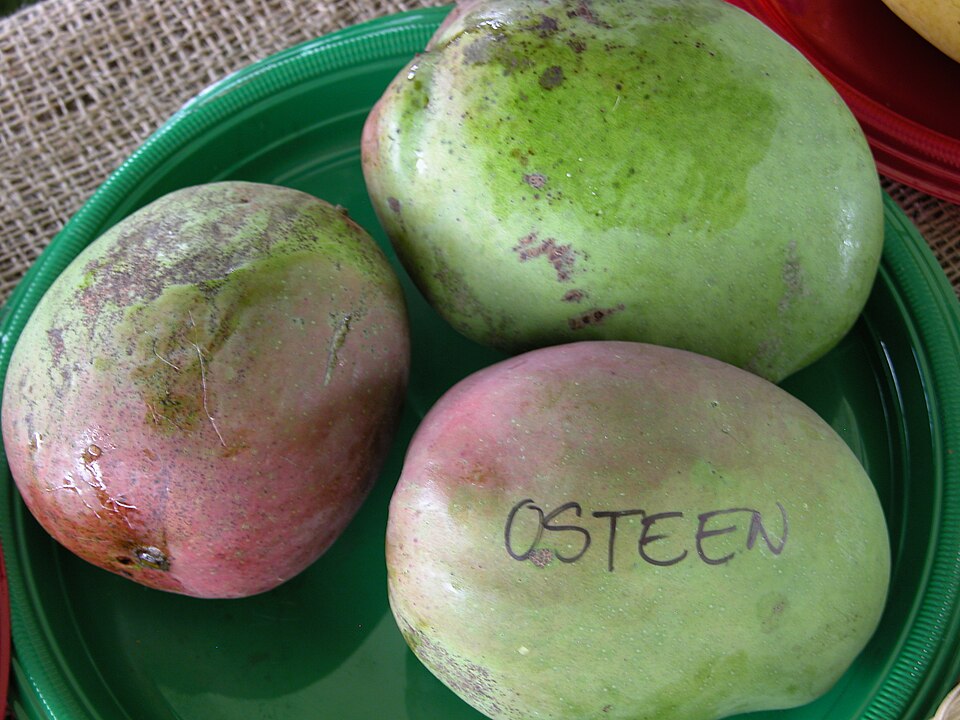
Labeled Osteen mangoes displayed at the Fruit & Spice Park, Florida. Maturity is not specified.
Mango Osteen Asit fs.jpg — Asit K. Ghosh (Thaumaturgist). Photograph source · CC BY-SA 3.0.

Resized for display; complete frame retained. No generative edits.
How it tastes
firm · Low fibre
- Texture
- firm
- Fibre
- Low fibre
- Eating styles
- Slice & eat
- Harvest
- See regional calendars
How to enjoy it
Osteen is widely associated with Spain’s mango-growing coast. Its purple skin looks dramatic; the flesh is mild and low in fibre. Judge readiness by feel as well as appearance.
Cut the cheeks away from the flat stone, then slice or cube. Use the ripeness notes below to choose the right stage.
When it is ripe
The purple skin can mislead; wait for a slight give and fruity aroma.
Flavour notes are subjective. Ripeness, handling and growing conditions change the fruit.
Compare this mango · Saved mangoes
Names, history & sources
Recorded names
A shared name does not by itself establish an identical cultivar. Place, language and source matter.
- Osteen
Named for S. A. Osteen, whose property held the seedling.
- Málaga Osteen
A growing-region descriptor, not the cultivar’s original birthplace.
From Merritt Island to Málaga
Documented history: consult the claims and qualifications in the cited sources.
A seed planted on S. A. Osteen’s Merritt Island property in 1935 first fruited in 1940. The family name stayed with the selection as it was propagated. It is generally regarded as a Haden seedling.
Osteen later became a commercial mango in Spain, giving it a second strong geographical identity. “Málaga Osteen” describes that growing home; it does not move the original tree across the Atlantic. The pleasure of this story is the journey: a Florida garden fruit becoming part of the Mediterranean harvest.
Read the full storyPlaces in this record
Country associations alone do not establish botanical origin.
- Spain
Catalogue association
Associated place in the tasting catalogue; this does not establish botanical origin.
- Spain
Recorded cultivation
The predominant cultivar in Andalusia’s 2023 agricultural account.
- Andalusia, mainland Spain
Recorded cultivation
The predominant cultivar in Andalusia’s 2023 agricultural account.
- Italy
Research trial
Included in the 2015 Acquedolci experiment; this record describes a trial.
- Acquedolci, Sicily, Italy
Research trial
Included in the 2015 Acquedolci experiment; this record describes a trial.
- Merritt Island, Florida → southern Spain
A place in the story
Setting of “From Merritt Island to Málaga”. Read the story for its evidence and qualifications.
- United States
A recorded historical connection
Place associated in the cited history; this is not a claim of botanical origin.
Harvest calendars by growing place. These regional calendars do not specify this cultivar’s exact season.