Keo Romeat
Crisp and tart while green, sweet and gently aromatic when fully ripe.
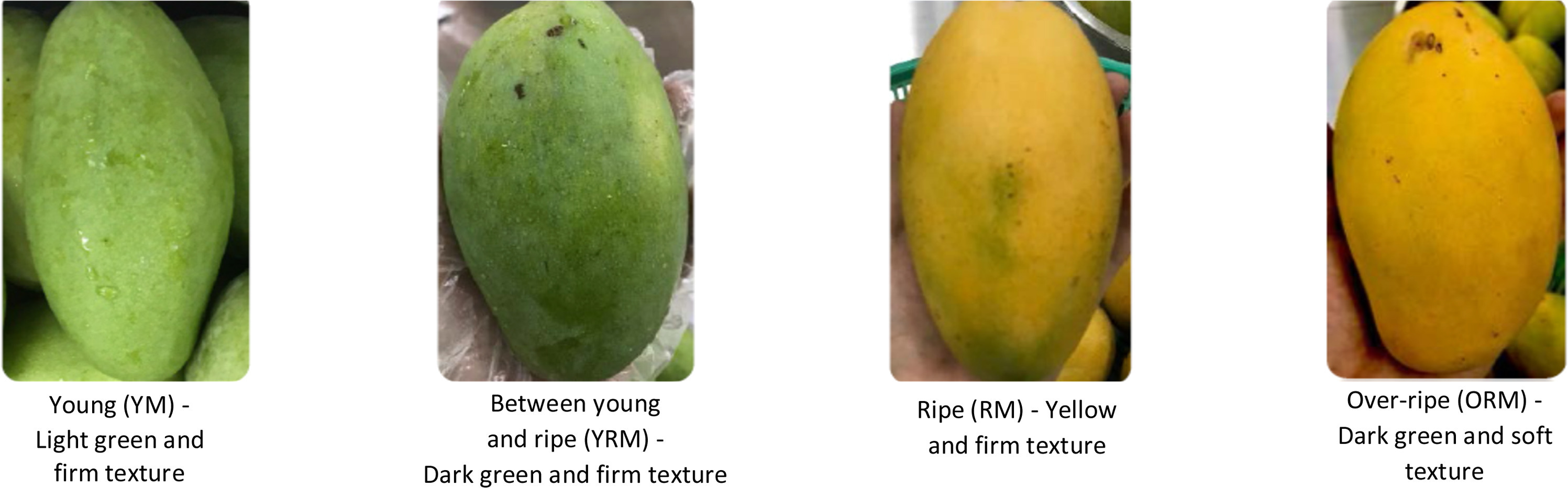
Keo Romeat from Kampong Speu, Cambodia, photographed at four maturity stages in Servent and coauthors (2026), Figure 1. The full figure and its original labels are preserved; the last panel’s printed colour description conflicts with its yellow appearance.
Keo Romeat mango maturity stages — Figure 1 — Adrien Servent, Marvin Soto, Tina Julien, Sela Cham, Savery Yon, Chanvorleak Phat and Elen Morm. Photograph source · CC BY 4.0.
Resized for display; complete frame retained. No generative edits.
How it tastes
firm · Low fibre
- Texture
- firm
- Fibre
- Low fibre
- Eating styles
- Slice & eat, Chilli & salt
- Harvest
- See regional calendars
How to enjoy it
Cambodia’s Keo Romeat is worth meeting at more than one stage. Firm fruit offers crunch; ripening changes the balance toward a softer, sweeter bite. Match the stage to the dish.
Cut the cheeks away from the flat stone, then slice or cube. Use the ripeness notes below to choose the right stage.
When it is ripe
Eat firm and green for crunch, or wait for yellow skin and a fruity aroma.
Flavour notes are subjective. Ripeness, handling and growing conditions change the fruit.
Compare this mango · Saved mangoes
Names, history & sources
Recorded names
A shared name does not by itself establish an identical cultivar. Place, language and source matter.
- Keo Romeat
- Keo Romeat / Keo Romiet / Keo Romet
Romanizations used for the Cambodian variety.
- Keo
A name element explained as glass in the Cambodian trade guide.
- Keo Romiet
Existing catalogue label. It may be an alternate name, translation or market nickname; it is not an assertion of genetic identity.
The mango that changes with the kitchen
Documented name: the history of the first tree remains unresolved.
Keo Romeat is one of Cambodia’s most familiar cultivated mangoes. A Cambodian trade guide explains keo through the pale flesh of the unripe fruit and its glass-like association. The spelling changes as the name moves between Khmer and English: Romeat, Romiet and Romet all appear in trade.
Its cultural story is also a story of stages. Cambodian producers describe people enjoying it fresh while green as well as ripe, and processors have carried it abroad as dried fruit. The sources do not establish a first breeder or mother tree, so this record keeps the everyday Cambodian name at the centre.
Read the full storyPlaces in this record
Country associations alone do not establish botanical origin.
- Cambodia
Catalogue association
Associated place in the tasting catalogue; this does not establish botanical origin.
- Cambodia; Kampong Speu and other growing provinces
A place in the story
Setting of “The mango that changes with the kitchen”. Read the story for its evidence and qualifications.
Harvest calendars by growing place. These regional calendars do not specify this cultivar’s exact season.