Kent
Big, smooth, sweet, and easy to find when you need a win.
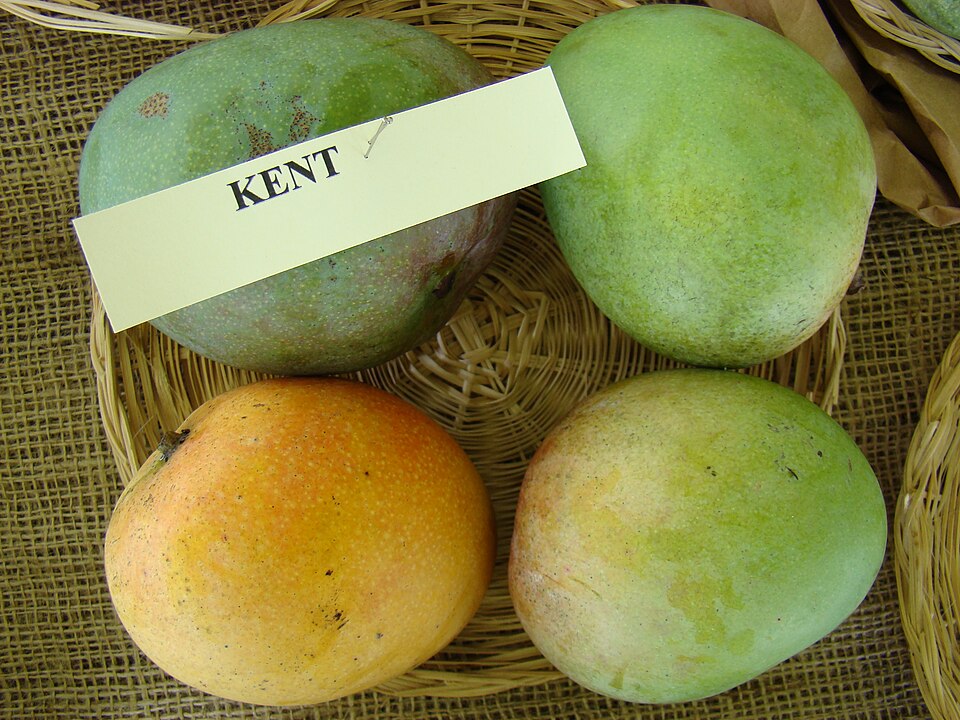
Kent mangoes displayed at the Redland Summer Fruit Festival, Florida. Individual fruit and maturity vary.
Mango Kent Asit fs8.jpg — Asit K. Ghosh (Thaumaturgist). Photograph source · CC BY-SA 3.0.

Resized for display; complete frame retained. No generative edits.
How it tastes
juicy · Low fibre
- Texture
- juicy
- Fibre
- Low fibre
- Eating styles
- Get sticky
- Harvest
- See regional calendars
How to enjoy it
Kent gives you broad cheeks and smooth, juicy flesh. It is a useful mango for sharing: slice it for the table and save any very soft pieces for a drink.
Open over a bowl to catch the juice. Scoop the ripe flesh; strain blended pulp if you prefer less fibre.
When it is ripe
A red blush is decoration; softness near the stem is the signal.
Flavour notes are subjective. Ripeness, handling and growing conditions change the fruit.
Compare this mango · Saved mangoes
Names, history & sources
Recorded names
A shared name does not by itself establish an identical cultivar. Place, language and source matter.
- Kent
Venezuela
Named for Leith Kent, on whose property the original seedling grew.
- Florida Kent
An origin descriptor, not a separate cultivar.
A Coconut Grove name on a world traveller
Documented history: consult the claims and qualifications in the cited sources.
Kent began as a Brooks seedling on the property of Leith Kent in Coconut Grove. Growers recognised both the quality of its fruit and the usefulness of its harvest, and the garden selection moved into commercial orchards.
Its name now turns up far from Florida, including Latin America and southern Africa. Kent also became a parent to later selections such as Gold Nugget. A surname on a supermarket sticker can conceal that whole chain: one person’s tree, other growers’ confidence, and new seedlings still being tried.
Read the full storyPlaces in this record
Country associations alone do not establish botanical origin.
- Florida
Catalogue association
Associated place in the tasting catalogue; this does not establish botanical origin.
- Venezuela
Catalogue association
A mango cultivar included in the Venezuelan INIA-CENIAP collection and flowering research.
- Spain
Recorded cultivation
Recorded as a less widespread, mid-season cultivar.
- Andalusia, mainland Spain
Recorded cultivation
Recorded as a less widespread, mid-season cultivar.
- United States
Catalogue association
Associated country guide; cultivation, naming and origin are different claims.
- Coconut Grove, Florida, United States
A place in the story
Setting of “A Coconut Grove name on a world traveller”. Read the story for its evidence and qualifications.
Harvest calendars by growing place. These regional calendars do not specify this cultivar’s exact season.