Keitt
Fresh, mild, and generous—excellent when everyone else has clocked out.
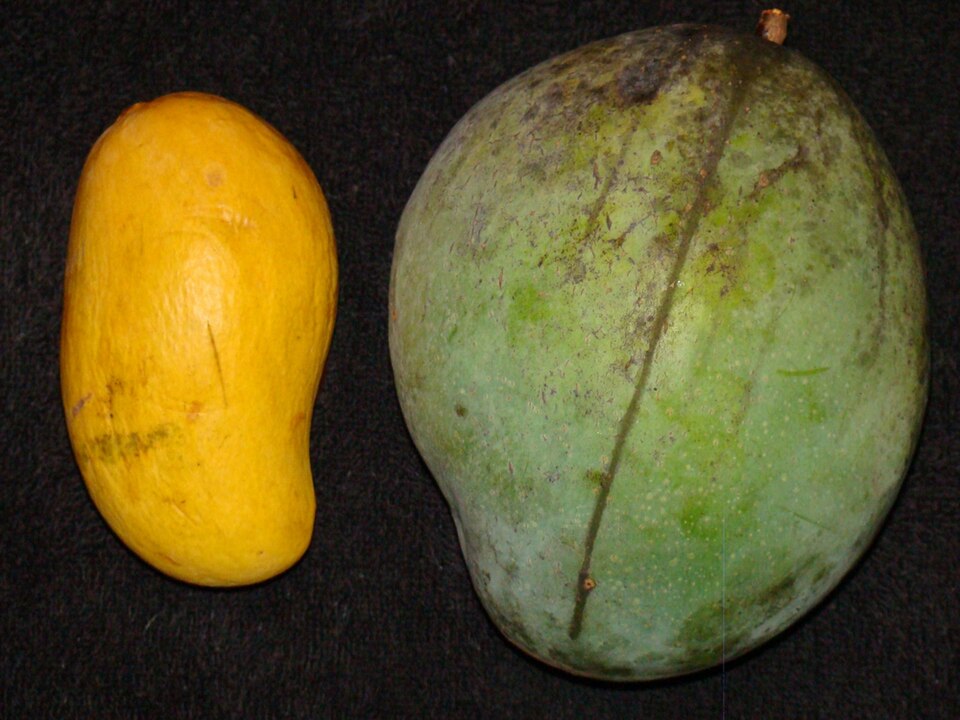
Ripe Keitt on the right; Ataulfo on the left for size comparison.
Mango ATAULFO KEITT Asit.jpg — Asit K. Ghosh (Thaumaturgist). Photograph source · CC BY-SA 3.0.

Resized for display; complete frame retained. No generative edits.
How it tastes
firm · Some fibre
- Texture
- firm
- Fibre
- Some fibre
- Eating styles
- Slice & eat
- Harvest
- See regional calendars
How to enjoy it
Keitt is a late mango with generous cheeks and a mild character. Its green skin can linger into ripeness. A soft shoulder is a more useful clue than a yellow peel.
Cut the cheeks away from the flat stone, then slice or cube. Use the ripeness notes below to choose the right stage.
When it is ripe
It often stays green; test for softness rather than color.
Flavour notes are subjective. Ripeness, handling and growing conditions change the fruit.
Compare this mango · Saved mangoes
Names, history & sources
Recorded names
A shared name does not by itself establish an identical cultivar. Place, language and source matter.
- Keitt
Venezuela
The surname attached to the Homestead selection.
- Late season green
A descriptive phrase, not a separate local cultivar name.
A family name at the end of summer
Documented history: consult the claims and qualifications in the cited sources.
Keitt was selected by the Keitt family in Homestead in the 1940s. Its generous late crop attracted commercial growers, and the name travelled with grafted trees into orchards across the Americas.
The parentage story has changed as evidence improved. It was historically described as a Mulgoba seedling; later assessments favour Brooks. The family name and Florida selection are the clear parts of the record. The late fruit itself explains why so many growers wanted to carry the tree forward.
Read the full storyPlaces in this record
Country associations alone do not establish botanical origin.
- Florida
Catalogue association
Associated place in the tasting catalogue; this does not establish botanical origin.
- Venezuela
Catalogue association
A mango cultivar included in the Venezuelan INIA-CENIAP collection and flowering research.
- Spain
Recorded cultivation
Recorded as Andalusia’s second predominant cultivar, with late ripening.
- Andalusia, mainland Spain
Recorded cultivation
Recorded as Andalusia’s second predominant cultivar, with late ripening.
- Italy
Recorded cultivation
Recorded at both sites in the 2025 orchard survey.
- Ficarazzi and Bagheria, Sicily, Italy
Recorded cultivation
Recorded at both sites in the 2025 orchard survey.
- United States
Catalogue association
Associated country guide; cultivation, naming and origin are different claims.
- Homestead, Florida, United States
A place in the story
Setting of “A family name at the end of summer”. Read the story for its evidence and qualifications.
Harvest calendars by growing place. These regional calendars do not specify this cultivar’s exact season.