Haden
Pretty skin, decent perfume, and fibers that refuse to leave the conversation.
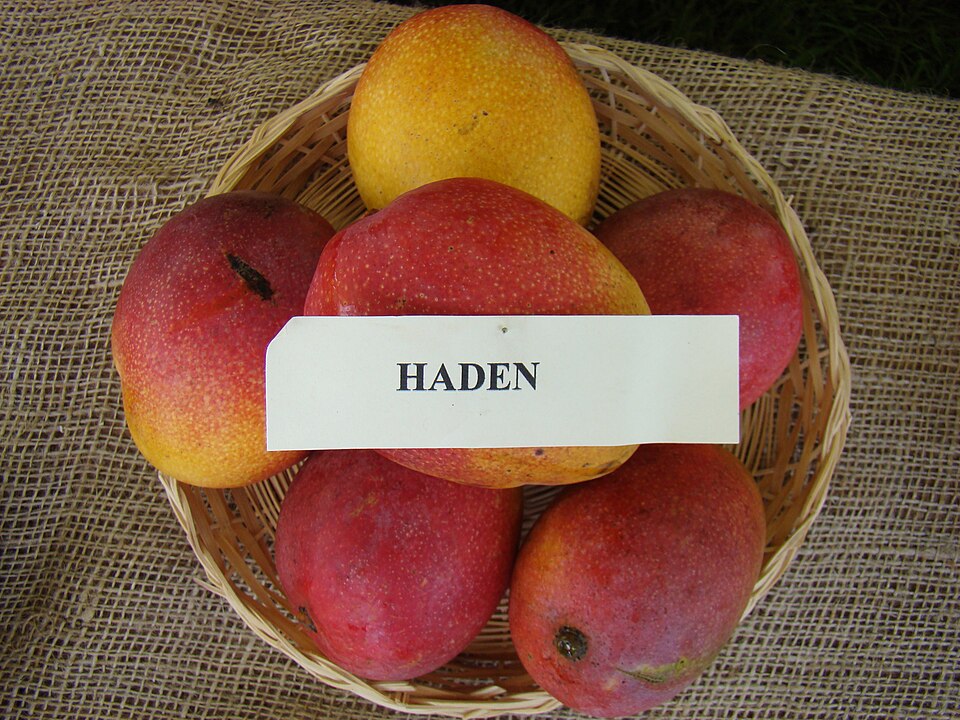
Haden mangoes displayed at the Redland Summer Fruit Festival, Florida. Individual fruit and maturity vary.
Mango Haden Asit fs8.jpg — Asit K. Ghosh (Thaumaturgist). Photograph source · CC BY-SA 3.0.

Resized for display; complete frame retained. No generative edits.
How it tastes
firm · Fibrous
- Texture
- firm
- Fibre
- Fibrous
- Eating styles
- Slice & eat
- Harvest
- See regional calendars
How to enjoy it
Haden is part of Florida’s mango history. Its bright skin and fragrant flesh come with noticeable fibre. Ripe pieces work well in a blender, but taste one on its own first.
Cut the cheeks away from the flat stone, then slice or cube. Use the ripeness notes below to choose the right stage.
When it is ripe
Choose for nostalgia, then keep a blender nearby.
Flavour notes are subjective. Ripeness, handling and growing conditions change the fruit.
Compare this mango · Saved mangoes
Names, history & sources
Recorded names
A shared name does not by itself establish an identical cultivar. Place, language and source matter.
- Haden
Venezuela
The Haden family surname, chosen by Florence Haden.
- Mulgoba
The recorded seed parent; a parent name, not an alias for Haden.
- Classic Florida
Existing catalogue label. It may be an alternate name, translation or market nickname; it is not an assertion of genetic identity.
Florence named the fruit he never saw
Documented history: consult the claims and qualifications in the cited sources.
In 1902, Captain John Haden planted dozens of seeds from Mulgoba fruit obtained from Elbridge Gale in West Palm Beach. Haden died before the promising seedling fruited. In 1910, his widow Florence recognised the fruit and gave it the family name.
Haden became a foundation of Florida’s commercial mango growing, and many later selections descend from it. Its legacy includes the many varieties that followed. This is a story of a person tending a tree long enough for someone else’s hope to bear fruit.
Read the full storyPlaces in this record
Country associations alone do not establish botanical origin.
- Florida
Catalogue association
Associated place in the tasting catalogue; this does not establish botanical origin.
- Venezuela
Catalogue association
A mango cultivar included in the Venezuelan INIA-CENIAP collection and flowering research.
- United States
Catalogue association
Associated country guide; cultivation, naming and origin are different claims.
- Coconut Grove, Florida, United States
A place in the story
Setting of “Florence named the fruit he never saw”. Read the story for its evidence and qualifications.
Harvest calendars by growing place. These regional calendars do not specify this cultivar’s exact season.