Carrie
Small and yellow with a cult-favorite rush of coconut, resin, and bubblegum.
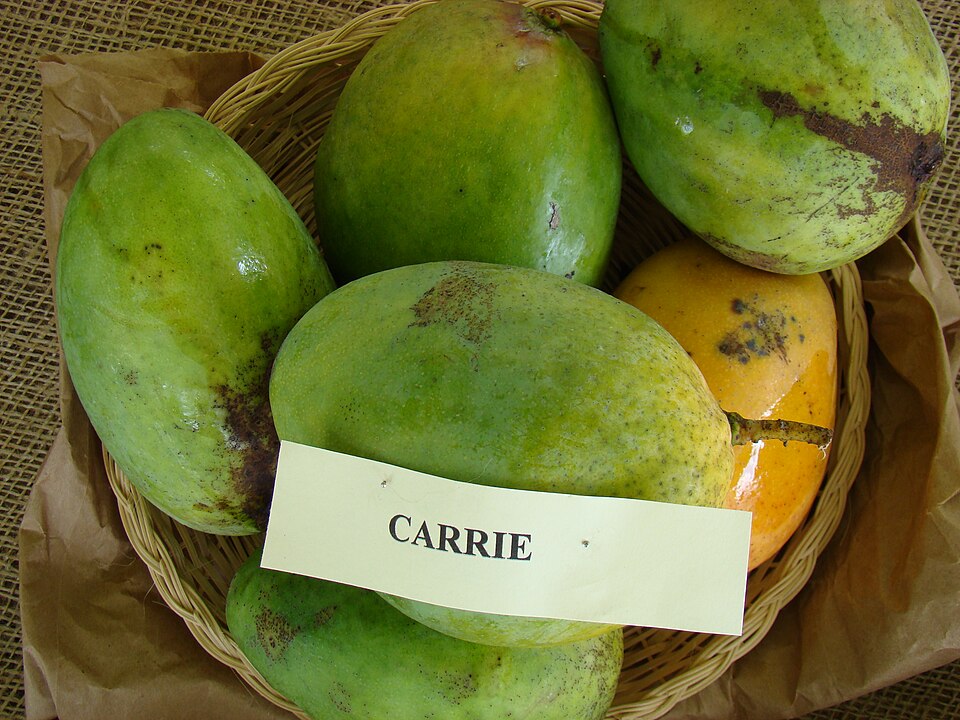
Carrie mangoes displayed at the Redland Summer Fruit Festival, Florida. Individual fruit and maturity vary.
Mango Carrie Asit fs8.jpg — Asit K. Ghosh (Thaumaturgist). Photograph source · CC BY-SA 3.0.

Resized for display; complete frame retained. No generative edits.
How it tastes
buttery · Low fibre
- Texture
- buttery
- Fibre
- Low fibre
- Eating styles
- Bring a spoon
- Harvest
- See regional calendars
How to enjoy it
Carrie can suggest resin, coconut or even bubblegum to different eaters. It is a mango to smell before you taste, and to eat when properly soft rather than simply colourful.
Cut ripe cheeks and scoop with a spoon. Taste the flesh plain before adding it to a dessert.
When it is ripe
Eat it fragrant and soft, often while the skin still carries some green.
Flavour notes are subjective. Ripeness, handling and growing conditions change the fruit.
Compare this mango · Saved mangoes
Names, history & sources
Recorded names
A shared name does not by itself establish an identical cultivar. Place, language and source matter.
- Carrie
Named for Carrie Zill, Laurence Zill’s mother.
- Sophie Frey / Sophia Frey
Names used for the seed parent, not aliases for Carrie.
- Carrie Zill mango
Existing catalogue label. It may be an alternate name, translation or market nickname; it is not an assertion of genetic identity.
A mother’s name, a lucky surviving tree
Documented history: consult the claims and qualifications in the cited sources.
Carrie was selected by the Zill family in the 1940s from a field of seedlings intended for rootstock. Its family line ran through Sophie Frey to the Caribbean Julie. Instead of remaining an anonymous support for a graft, this seedling became worth growing for its own fruit.
The family named it for Carrie Zill, Laurence Zill’s mother. It is a lovely reversal of the usual catalogue story: a fruit now admired by collectors began in practical nursery work and kept a mother’s name. Later selections, including Angie, continued that family of mangoes.
Read the full storyPlaces in this record
Country associations alone do not establish botanical origin.
- Florida
Catalogue association
Associated place in the tasting catalogue; this does not establish botanical origin.
- Italy
Research trial
Grown in the nine-cultivar orchard experiment conducted in 2015 and published in 2019.
- Acquedolci, Sicily, Italy
Research trial
Grown in the nine-cultivar orchard experiment conducted in 2015 and published in 2019.
- United States
Catalogue association
Associated country guide; cultivation, naming and origin are different claims.
- Boynton Beach / Delray Beach, Florida, United States
A place in the story
Setting of “A mother’s name, a lucky surviving tree”. Read the story for its evidence and qualifications.
Harvest calendars by growing place. These regional calendars do not specify this cultivar’s exact season.