Banganapalli
Large golden fruit with firm fiberless flesh and a clean honey sweetness.
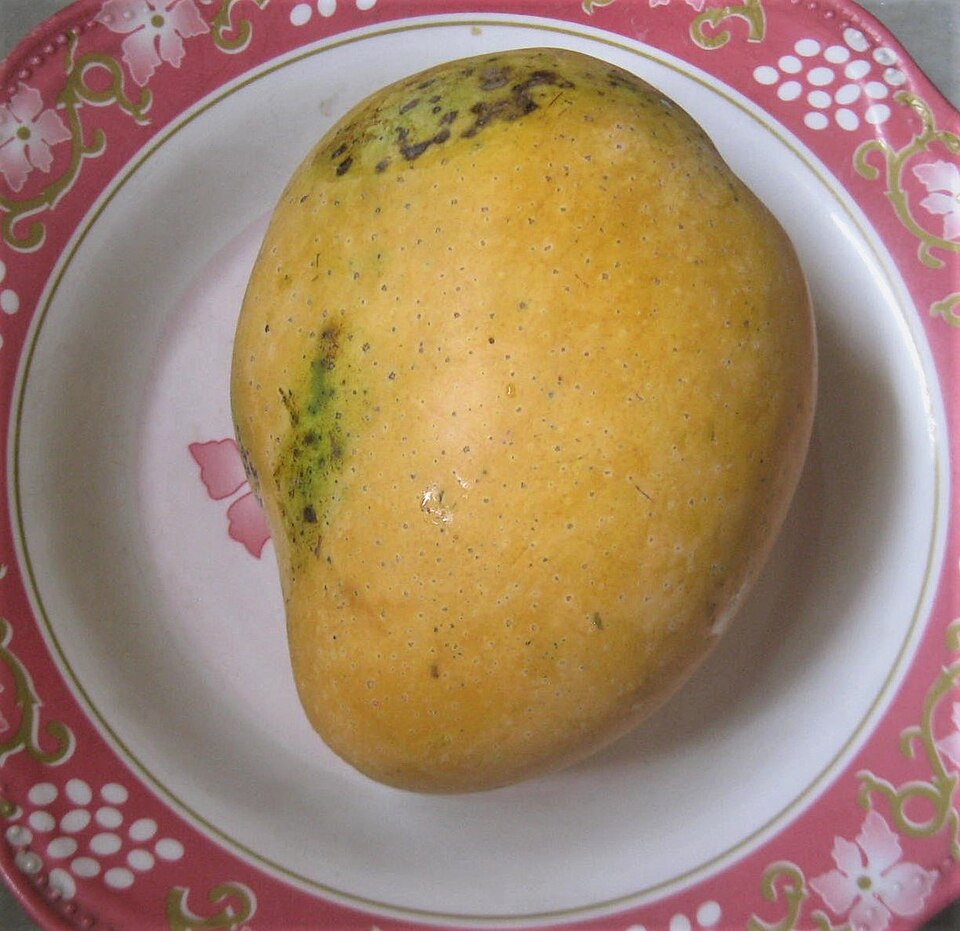
A Banganapalle mango photographed by Salil Kumar Mukherjee; also known as Banganapalli.
'Banganapalle' mango.jpg — Salil Kumar Mukherjee. Photograph source · CC BY-SA 4.0.

Resized for display; complete frame retained. No generative edits.
How it tastes
Honeyed · Mellow · Meaty
- Texture
- firm
- Fibre
- Low fibre
- Eating styles
- Slice & eat
- Harvest
- See regional calendars
How to enjoy it
Also called Benishan or Safeda, Banganapalli takes its name from a town in Andhra Pradesh. Its pleasure is in the bite: generous, meaty cheeks that hold a slice, with very little fibre. Firm flesh can be perfectly ripe. You do not have to wait for every mango to become a soft, dripping handful.
Cut along either side of the flat stone. Slice the cheeks into thick crescents, peel, and eat just as they are. This is a mango for a full plate of generous pieces.
When it is ripe
Look for even golden-yellow skin and a light sweet scent.
Golden-yellow skin, sometimes with small dark speckles. Inside: yellow, firm, low-fibre flesh.
Eating it green
Hard green fruit is a different eating stage. For sweet slices, wait for a little give and a sweet scent.
Flavour notes are subjective. Ripeness, handling and growing conditions change the fruit.
Compare this mango · Saved mangoes
Names, history & sources
Recorded names
A shared name does not by itself establish an identical cultivar. Place, language and source matter.
- Banganapalli
- Bangan Pali
Pakistan
- Banganpali
Pakistan
- Beganpali
Pakistan
- Bagan Pali
Pakistan
- Banganapalli / Banganapalle
The cultivar name preserves its association with the Andhra town.
- Baneshan / Benishan
Common alternative spellings used for this mango.
- Safeda
A recorded market synonym; the word is also used for other mangoes in some regions.
- பங்கனபள்ளி
Tamil · Tamil Nadu, India
Tamil spelling used in TNAU’s mango image caption; the same page also uses பங்கனப்பள்ளி.
- Benishan
Existing catalogue label. It may be an alternate name, translation or market nickname; it is not an assertion of genetic identity.
A town travels inside a mango
Documented history: consult the claims and qualifications in the cited sources.
Banganapalli carries the name of Banganapalle, the Andhra town associated with the mango and its former nawab. India’s regional-product catalogue preserves the nawab connection; horticultural records preserve the cultivar’s wide southern cultivation. The available accounts do not provide a secure biography of its very first tree.
As the fruit moves, its name changes. The National Horticulture Board records Baneshan and Safeda alongside Banganapalli. A familiar market name can be as meaningful as a place name, although a seller’s use of Safeda on its own is not enough to identify every mango with certainty.
Read the full storyPlaces in this record
Country associations alone do not establish botanical origin.
- India
Catalogue association
Associated place in the tasting catalogue; this does not establish botanical origin.
- Pakistan
Catalogue association
Listed among varieties grown in Pakistan. Shares the Banganapalli profile and its Andhra Pradesh name history.
- Banganapalle, Andhra Pradesh
A place in the story
Setting of “A town travels inside a mango”. Read the story for its evidence and qualifications.
Harvest calendars by growing place. These regional calendars do not specify this cultivar’s exact season.
Sources
- Trade Development Authority of Pakistan: Mango sector (2025)
- Planning Commission / CABI: Mango Cluster Study (2020), Table 3
- Government of India: One District One Product catalogue
- National Horticulture Board: Mango cultivar and hybrid descriptions
- Banganapalli: variety reference
- Tamil Nadu Agricultural University: Mango cultivation (Tamil)