Alphonso
Saffron, apricot jam, and an almost unfairly lush finish—the “king of mangoes” earns the title.
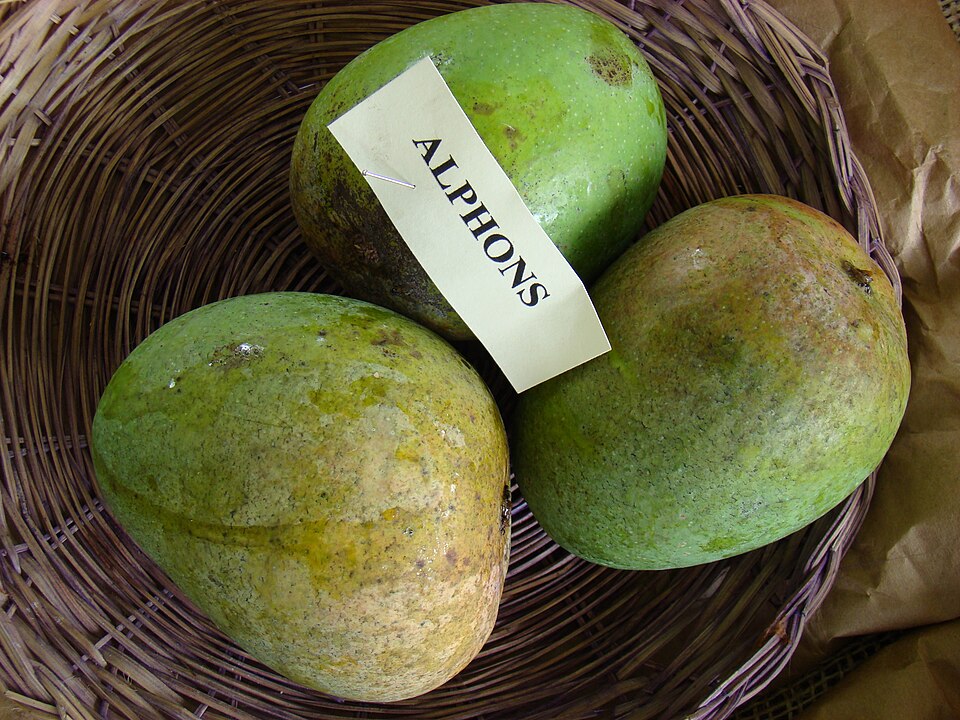
Alphonso mangoes displayed at the Redland Summer Fruit Festival, Fruit and Spice Park, Florida. Maturity is not specified.
Alphonso FS AKG.JPG — Asit K. Ghosh Thaumaturgist. Photograph source · CC BY-SA 3.0.

Resized for display; complete frame retained. No generative edits.
How it tastes
Apricot · Rich sweetness · Floral
- Texture
- buttery
- Fibre
- Low fibre
- Eating styles
- Bring a spoon
- Harvest
- See regional calendars
How to enjoy it
Hapus is closely associated with the Konkan coast, especially Ratnagiri and Devgad. Cut through the skin and the appeal becomes obvious: richly coloured flesh, a thick creamy texture, and a perfume that stays with you. Our favourite way to understand it is to taste a plain spoonful before adding anything.
Scoop from the cheeks, or press the flesh into aamras. Taste it plain first; it already brings plenty of sweetness.
When it is ripe
Give gently at the shoulders; the perfume should arrive before the bite.
Yellow to golden skin, sometimes retaining green patches; orange-yellow flesh inside. Aroma and a gentle give matter more than colour alone.
Flavour notes are subjective. Ripeness, handling and growing conditions change the fruit.
Compare this mango · Saved mangoes
Names, history & sources
Recorded names
A shared name does not by itself establish an identical cultivar. Place, language and source matter.
- Alphonso
Traditionally linked to the name of Afonso de Albuquerque.
- Hapus / Happus
Local name and spelling recorded in Indian horticultural and historical sources.
- हापूस
Marathi · Ratnagiri, Maharashtra, India
Ratnagiri’s official Marathi site names Hapus in its title; the English version calls the fruit Alphonso.
- அல்போன்சா
Tamil · Tamil Nadu, India
Tamil spelling recorded in TNAU’s mango cultivation guide.
- Hapus
Existing catalogue label. It may be an alternate name, translation or market nickname; it is not an assertion of genetic identity.
A Portuguese name, a Konkan home
Local tradition: an attributed account, with uncertainty preserved.
The familiar naming account links Alphonso to Afonso de Albuquerque, the Portuguese governor associated with Goa. Grafting in Portuguese-era Goa forms part of the wider story of how prized mango selections travelled. That is a naming and cultivation history; it does not mean mangoes themselves arrived in India from Europe.
Along the Konkan coast, Hapus is the more intimate name. Ratnagiri’s fruit is celebrated in India’s regional-product catalogue, tying the mango’s reputation to a particular landscape and its growers. The grand name may travel on the export box; the local name is what someone asks for at home.
Read the full storyPlaces in this record
Country associations alone do not establish botanical origin.
- India
Catalogue association
Associated place in the tasting catalogue; this does not establish botanical origin.
- Konkan coast, especially Ratnagiri and Sindhudurg, Maharashtra
A place in the story
Setting of “A Portuguese name, a Konkan home”. Read the story for its evidence and qualifications.
Harvest calendars by growing place. These regional calendars do not specify this cultivar’s exact season.
Sources
- NIFTEM–Thanjavur: Mango processing project report, variety history
- Spencer Low: Alphonso and its Portuguese name
- Government of India: One District One Product catalogue
- National Horticulture Board: Mango cultivar and hybrid descriptions
- Alphonso: variety reference
- Ratnagiri district: Marathi official site — famous for Hapus mangoes
- Ratnagiri district: English official site — famous for Alphonso mangoes
- Tamil Nadu Agricultural University: Mango cultivation (Tamil)